
Why drivers break rules they know well. Learn how habits, social pressure, and road culture shape driving behaviour across Canada.
| 80-90% Collisions Linked to Human Behaviour | 9.2% Drivers Admit Driving Over Legal Limit | 71.8% View Impaired Driving as Serious (lowest in 20 yrs) | 50% Accept Speeding on Freeways |
We all know the rules of the road. We learn them before getting a licence, repeat them during renewals, and see them reinforced on signs, apps, and public campaigns. Yet on any given day in Canada, we also see speeding, late yellow decisions, rolling stops, distracted glances at phones, and hesitation where confidence is needed. This contradiction sits at the heart of road safety culture.
KEY FINDING: The Behaviour-Attitude Paradox
Surveys consistently find that most drivers say they disapprove of risky behaviours such as impaired driving, texting behind the wheel, or speeding in school zones. Yet self-reported behaviour tells a different story. Knowing the rules, it turns out, is not the same as following them.
Source: Traffic Injury Research Foundation, Road Safety Monitor 2025
This page looks at why that gap exists. It is not about blame or punishment. It is about understanding how everyday driving decisions are shaped, how unsafe norms form, and why changing behaviour requires more than laws alone.
What “Road Safety Culture” Means

Road safety culture is not a policy document or a checklist. It is the shared set of habits, expectations, and unspoken rules that drivers, pedestrians, and cyclists absorb over time.
It shows up in small, familiar moments:
- “Everyone drives about 10 km/h over here.”
- “A rolling stop is fine if no one’s around.”
- “Hands-free calls are basically safe.”
- “If the light just turned yellow, I can make it.”
u/Shawn_Resatz on r/AskCanadians:
“Our great driving distances make people faster drivers, so everyone goes 10+ km/hour above speed limit as well. Canadians are also more aggressive than most stereotypes suggest.”
None of these ideas come from traffic law. They come from observation. We watch what others do, notice what goes unchallenged, and adjust our own behaviour. Over time, those adjustments harden into norms. Once that happens, changing behaviour becomes much harder than issuing a new rule.
Researchers studying traffic safety culture in Canada describe it as a collective mindset. It reflects what people believe is acceptable on the road, even when those beliefs conflict with formal laws or personal values.
The Belief–Behaviour Gap
One of the clearest findings in Canadian road safety research is this: drivers often act against their own stated beliefs.
What Canadians Say vs. What They Do:
| HIGH CONCERN (>85% unacceptable) → Speeding in school zones → Texting/emailing while driving → Hand-held phone use → Drowsy driving → Red light violations → Impaired driving | LOWER CONCERN (40-50% acceptable) → Speeding 20 km/h over on freeways → Speeding 10 km/h over on residential → Speeding 10 km/h over in urban areas → Hands-free phone use |
Source: Mishra & Mehran, Traffic Safety Culture of Drivers in Canada, IATSS Research 2025
This gap exists for several reasons:
- Habit and routine – Driving is repetitive. Familiar routes encourage autopilot behaviour, especially during commutes. Once a habit forms, conscious decision-making fades.
- Risk feels abstract – Crashes are statistically rare at an individual level. After thousands of uneventful trips, it becomes easy to believe serious outcomes happen to others.
- Lack of immediate consequences – When risky behaviour does not lead to tickets or close calls, it feels validated. Over time, the absence of consequences becomes its own signal.
- Context overrides values – Time pressure, fatigue, weather, or congestion often matter more in the moment than what we believe is “right.”
u/James_Oldman on r/AskCanadians:
“The speed limits are just too slow for the modern vehicle. My first vehicle cruised nicely at 45 MPH. Today my current vehicle cruises nicely at 140 km/h. Highways have improved. Vehicles have improved with better handling, stopping distance and safety items.”
Social Pressure Behind the Wheel
Driving is a social activity, even when we sit alone in a vehicle. The behaviour of others constantly influences our decisions.
Common pressures include:
- Keeping up with traffic, even when it exceeds the limit
- Avoiding being the slowest driver, especially in urban flows
- Responding to tailgating, often by accelerating or making rushed turns
- Assuming others expect us to go, even when caution would be safer
These pressures are subtle, but powerful. Studies of driver behaviour show that people frequently adjust speed, gap acceptance, and signal timing to match surrounding traffic, not posted rules.
A simple question reveals the problem: If everyone around you is doing it, does it still feel like a choice?
How Dangerous Norms Are Formed
Unsafe driving norms rarely appear overnight. They develop through a predictable chain:
| 1 Risky action occurs without consequence | 2 Behaviour is repeated | 3 Others observe and imitate | 4 Becomes seen as “normal” | 5 Resistance to change emerges |
Speed tolerance is a classic example. When exceeding the limit becomes routine and unenforced, it stops feeling like a violation. The same pattern appears with rolling stops, late yellow entries, and casual phone use.
Once norms are established, enforcement alone struggles to reverse them. People do not like feeling singled out for behaviour they see everywhere.
What Canadian Data Tells Us
Canadian research provides a clear picture of this disconnect between attitudes and actions.
KEY FINDING: The Impaired Driving Warning Signal
Self-reported drinking and driving behaviours increased sharply in 2025, with approximately one in ten (9.2%) of drivers admitting to driving when they believed they were over the legal limit – up from 5.9% in 2024, a 56% increase in one year. Among those who admitted driving impaired, 27.7% had been drinking at bars and 24.2% with friends and relatives.
Source: Traffic Injury Research Foundation, Road Safety Monitor 2025
According to findings published by the Traffic Injury Research Foundation, most Canadian drivers strongly support laws against impaired driving, distracted driving, and speeding in school zones. Support often exceeds 80% for these measures.
At the same time, the same research shows that many drivers consider certain behaviours less threatening in practice. Speeding on freeways, modest speeding in urban areas, and hands-free phone use are often viewed as minor risks despite evidence linking them to collision severity.
KEY FINDING: Age and Risk Acceptance
The percentage of drivers accepting highway speeding drops dramatically with age: 60-90% acceptance at ages 19-25, dropping to 45-60% at 26-40, 35-50% at 41-55, 20-30% at 56-70, and just 10-15% for drivers over 70. Drivers aged 20-34 who are fatally injured in crashes are the most likely to test positive for alcohol (41.2%).
Source: Mishra & Mehran (2021); TIRF National Fatality Database 2019-2023
Data from Transport Canada reinforces this pattern. National collision statistics repeatedly show that human error remains the dominant contributing factor in serious crashes, even as vehicles and infrastructure become safer.
In other words, Canada has made progress through policy and technology, but behaviour continues to limit those gains.
Why Enforcement Alone Isn’t Enough
Enforcement matters. Seatbelt laws, impaired driving enforcement, and automated speed cameras have all saved lives. Canadian fatality rates per kilometre travelled remain significantly lower than in countries with weaker enforcement frameworks.
| CANADA18% decreasein fatalities 2011-2020 | UNITED STATES33% increasein fatalities 2011-2021 |
Source: IIHS/TIRF Comparative Study, July 2025
Yet enforcement works best as a short-term corrective, not a long-term cultural shift.
When enforcement is inconsistent or perceived as targeted rather than universal, behaviour often rebounds. Drivers adapt by slowing down only at known camera locations or resuming old habits once attention fades.
A recurring insight from safety researchers: People do not just follow laws. They follow expectations.
If the expectation on a road is that everyone speeds, enforcement must be constant to counter it. Changing expectations, however, reduces the need for constant correction.
Shifting Road Safety Culture
Research across Canada and other high-income countries points to several principles that support safer behaviour over time:
- Predictability – Clear road design and signal timing reduce guesswork and last-second decisions.
- Consistency – When rules are applied broadly and fairly, compliance feels normal rather than punitive.
- Social signalling – Public messaging that reflects real behaviour, not ideal behaviour, resonates more strongly.
- Behaviour-focused education – Programs that explain why people take risks outperform fear-based campaigns.
KEY FINDING: Policy Differences That Save Lives
The IIHS/TIRF study identified specific Canadian policies that explain better outcomes: stronger distracted driving laws covering more population, stricter seat belt laws, more widespread speed safety cameras, low-BAC penalties in all provinces except Quebec, and mandatory alcohol screening allowing roadside tests without suspicion of impairment.
Source: Insurance Institute for Highway Safety & TIRF, July 2025
Importantly, none of these rely on shame. They acknowledge that risk-taking is human and focus on shaping environments where safer choices feel natural.
Why This Matters Most at Intersections
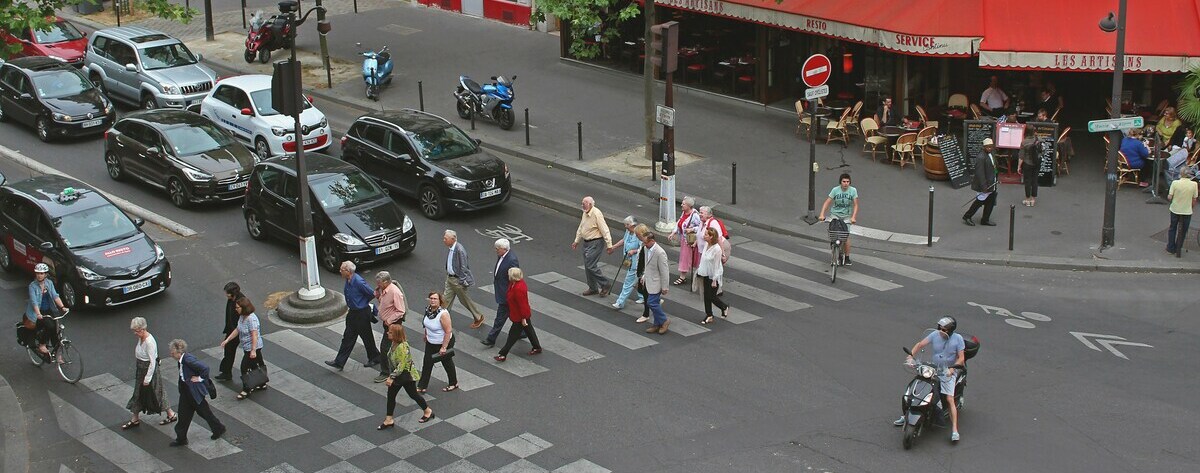
Intersections are where road safety culture becomes visible.
They bring together drivers with different assumptions, pedestrians with varying mobility needs, cyclists navigating exposure, and signals that require rapid interpretation. Many serious collisions occur not because someone ignored the rules entirely, but because expectations did not align.
u/carvythew on r/Winnipeg:
“It’s the same design issue at every four lane stroad without a turn signal. If two drivers are turning left and can’t see past each other at the yellow, there’s always going to be a risk when a car going straight goes through late.”
Common conflicts include:
- Left turns made under pressure
- Pedestrians assumed to yield
- Late yellow decisions misjudged by opposing traffic
- Reduced traction and visibility in winter
“A simple left turn illustrates the challenge. One driver judges the speed of oncoming traffic. Another expects that driver to wait. A pedestrian steps off the curb when the signal changes. None of these actions are reckless on their own. Together, they create a narrow margin for error.”
At intersections, a single incorrect assumption can undo multiple layers of protection. That is why understanding behaviour matters as much as engineering.
Key Takeaway
Road safety is not only a matter of education or enforcement. It is shaped by habits, social cues, and what people come to see as normal.
When we talk about improving safety, especially in complex environments like intersections, we have to look beyond the rulebook. Understanding why people break rules, and how those behaviours spread, is essential to making roads safer for everyone.
We all play a role in that culture, whether we notice it or not.
Sources & Further Reading
- Traffic Injury Research Foundation. (2025). Road Safety Monitor: Drinking & Driving in Canada.
- Mishra, S. & Mehran, B. (2021). Traffic safety culture of drivers in Canada. IATSS Research.
- Insurance Institute for Highway Safety & TIRF. (2025). Strong road safety policies have helped keep Canada on track.
- Transport Canada. (2023). Canadian Motor Vehicle Traffic Collision Statistics.
- MADD Canada & TIRF Webinar. (2025). Canada’s Impaired Driving Landscape: New Data & Emerging Solutions.